

photo by Joann Pensabene
Dawn through the trees. Red and orange streaks across Wednesday’s sky.
My reaction, strong, the verse, reflexive:
“Red sky in the morning/sailor take warning. Red sky at night/ sailor’s delight.”
A memory fragment. Children’s voices from my past reaching across time, reciting the rhyme by rote during a grammar school lesson on proverbs. The simple saying, steeped in Western culture, secured me to humanity’s past. Definite assurance here. Sky and verse, together, offered me incontrovertible proof that rain was in my day.
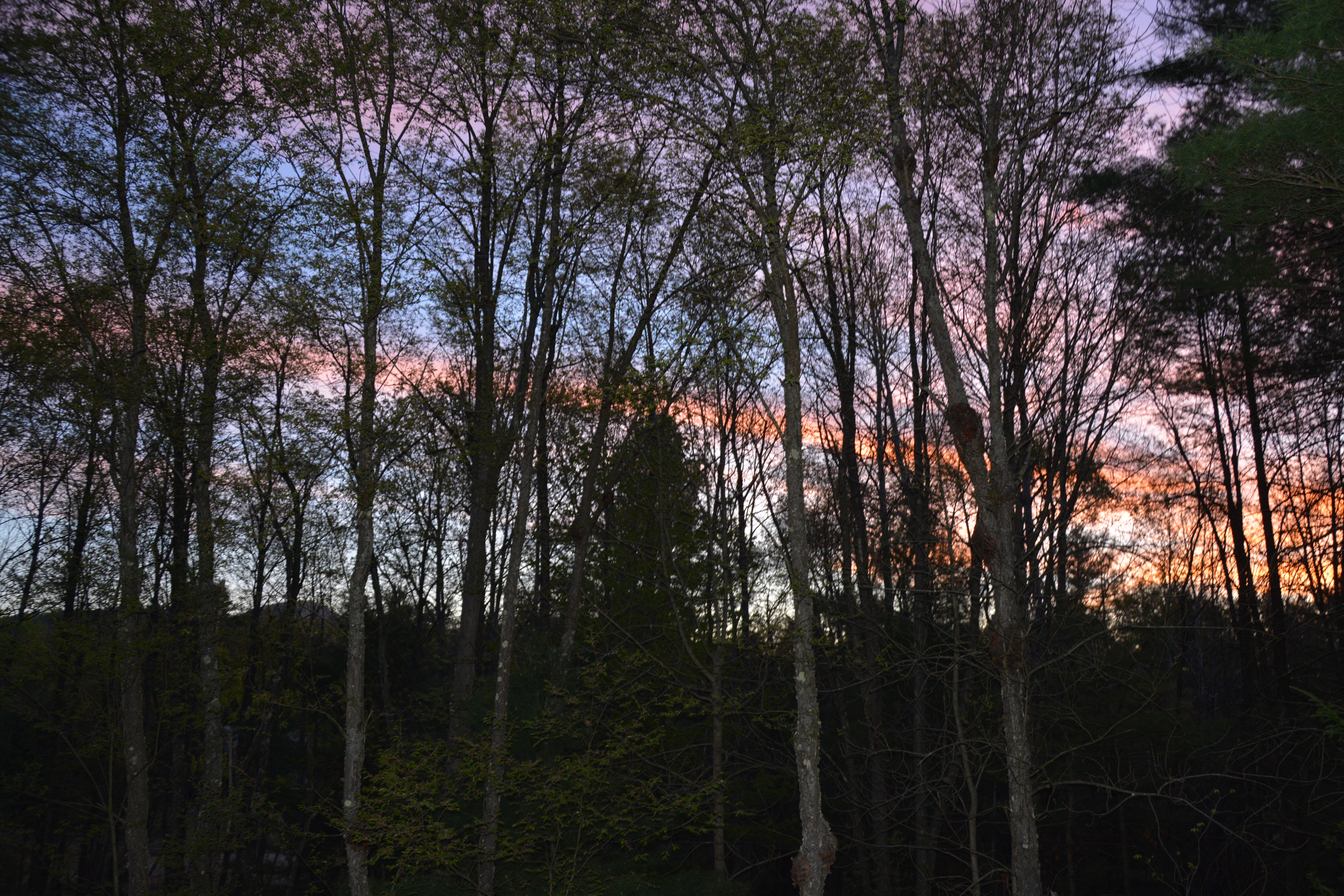
photo by Joann Pensabene
Ancient people studied the natural world and predicted weather patterns based on repeated observations. Their predictions guided their decisions in farming, animal grazing, and sailing.
The “red sky verse,” often thought of as a cute, children’s poem today, was actually a cultural tool, a piece of oral history set into an adage. Repeated across generations it lives in our collective memory. Our ancestors used verse to memorize their interpretations of meteorological events as they organized their world and enhanced their chances of survival.
We humans are a creative lot and our observations across millennia connect us. We’re also an expressive lot. We devise incredible varieties of forms to present our gathered data. The “red sky verse” is only one of many. And, just for the record, the British and Australian version of the poem presents a shepherd as its subject rather than a sailor. I sometimes wonder whether early American pioneers might have thought, “Red sky in the morning/settler take warning…?”

photo by Joann Pensabene
An early written account of the red sky phenomenon can be found in the Bible. Jesus says to the Pharisees:
“…when it is evening, you say, ‘It will be fair weather for the sky is red.’ And in the morning, ‘It will be stormy today for the sky is red and threatening.’ You know how to interpret the appearance of the sky but you cannot interpret the signs of the times ” (Matthew 6:2-3, New Revised Standard Version.)
A sign of our own times, of course, is the evolution of sophisticated scientific techniques we now use to present our observations of natural occurrences. We’ve replaced our reliance on adages with experts who interpret events in ways our ancestors could never have envisioned. All an ordinary, technologically connected person need do is watch reports on The Weather Channel, listen to predictions on local radio stations, or tap on iPhone Apps to find out conditions in any given part of the world at any given moment. And we can track and view the impact of weather on the physical, psychological, social, and environmental consequences endured by our fellow humans in real time and respond with appropriate support.

photo by Joann Pensabene
Such is a result of living in a global-networked culture. It’s wonderful to have electronic data at our fingertips and to feel confident in the high probability of their veracity. Understanding that red sky phenomena are caused by debris and moisture caught in cloud formations as weather patterns move in specific directions did satisfy my intellectual craving about what I saw out my window the other day.
Yet the red and orange streaks across the sky through the woods behind my house was a heart-stopping moment that culminated in pleasure and wonder. Natural art. A brilliant picture that glowed and faded as the sun rose higher in the sky, beauty I could only partially capture with the camera.
And what about the veracity of the ancient verse?* Though actual studies of it’s accuracy have been done, the science jurists are split. Perhaps someday someone may come up with a statistically stable result.
Finally, what did the weather do on Wednesday? I leave you with my own observations compiled by looking out my window and without benefit of reports from the professionals. The day yielded alternating sun and clouds and late in the afternoon, we had a good, soaking rain.
___________________________
*The links below offer contrasting info re: red sky validity.
http://www.almanac.com/fact/does-the-weather-proverb-red-sky-at
http://www.nbc12.com/story/15740269/can-a-red-sky-warn-you-of-impending-weather








 Pics and Posts